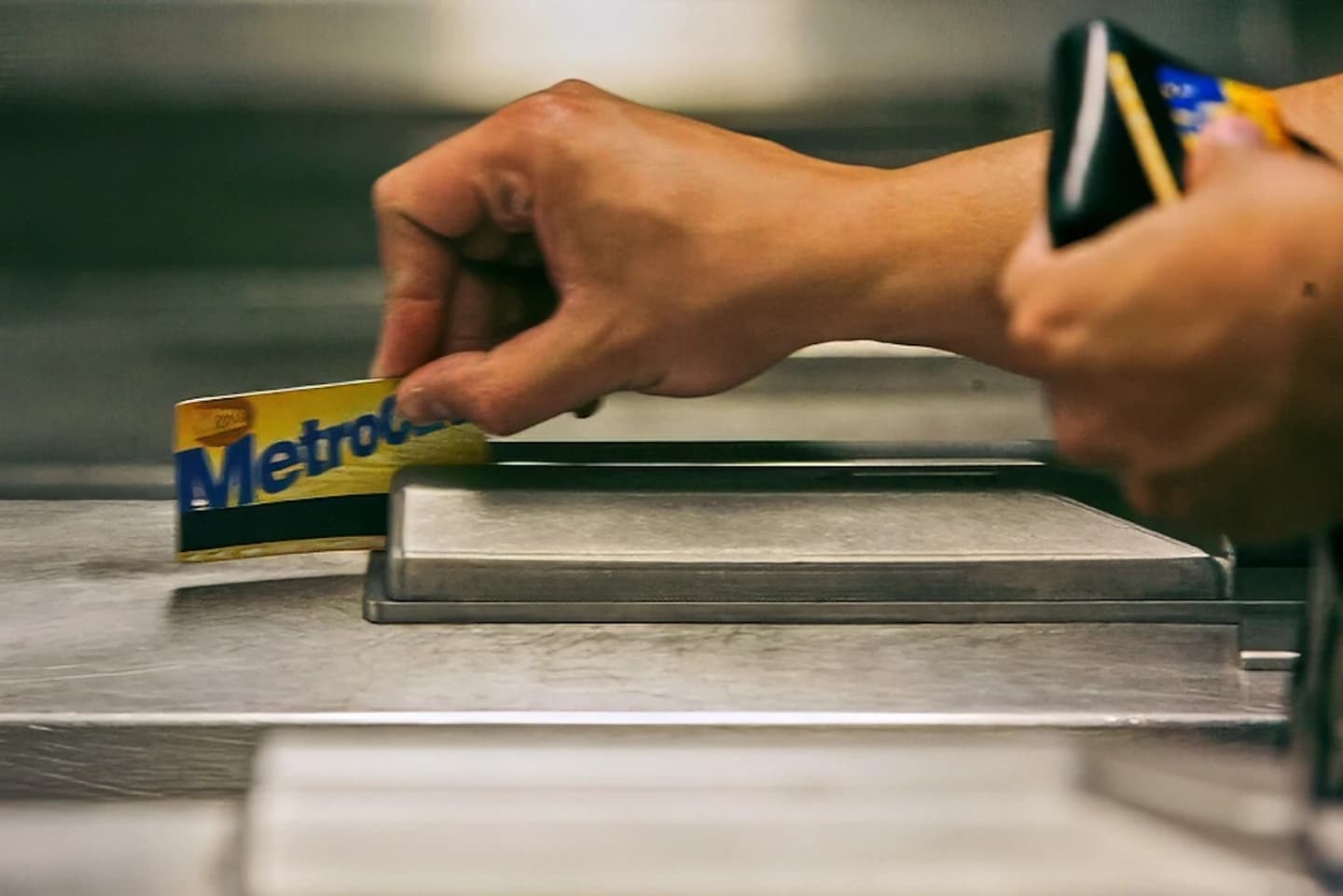
NEW YORK (AP) — When the MetroCard debuted in 1994, replacing the longstanding subway tokens, it brought a new level of modernity to one of the world’s oldest and busiest transit systems.
Now, over 30 years later, the iconic gold-colored card and its often finicky magnetic strip are set to become a thing of the past as the subway fully transitions to OMNY, a contactless fare payment system.
The last day to purchase or reload a MetroCard will be December 31, 2025. After that, riders will pay fares by simply tapping their credit card, smartphone, or other smart device—similar to contactless payments used for everyday transactions.
According to transit officials, more than 90% of subway and bus trips are already paid using the tap-and-go system, which was introduced in 2019.
Similar contactless payment systems have long been used in major cities worldwide, including London and Singapore. This year, San Francisco rolled out its own pay-as-you-go system, joining Chicago and other U.S. cities.
A Revolutionary Change in Commuting
The modest MetroCard was revolutionary in its time, says Jodi Shapiro, curator at the New York Transit Museum in Brooklyn, which recently opened an exhibit celebrating the card’s legacy.
Before MetroCards, riders used tokens—brass coins introduced in 1953—that were bought at station booths. When the subway first opened in 1904, paper tickets cost just five cents, equivalent to roughly $1.82 today.
“There was resistance to switching from tokens because they worked,” Shapiro explained during a visit to the museum, located underground in a former subway station. “MetroCards brought a whole new way of thinking for New Yorkers.”
To ensure smooth adoption, the Metropolitan Transportation Authority launched campaigns teaching riders how to swipe the blue-colored cards properly, avoiding errors or lost fares. Officials briefly considered a mascot, the “Cardvaark,” but ultimately decided against it.
Over the years, MetroCards became collectible items, commemorating events like the 2000 World Series “Subway Series” between the Mets and Yankees, when a fare was $1.50. Artists—ranging from David Bowie and Olivia Rodrigo to iconic hip-hop acts like Wu-Tang Clan, Notorious B.I.G., and LL Cool J—also featured on the cards. The cards even appeared in popular TV shows such as Seinfeld and Law & Order.
“Some of the most meaningful cards are those that showcase New York City to the world,” said Lev Radin, a Bronx collector. “They feature landmarks, skylines, and the diverse people who make the city special.”
Mastering the perfect swipe angle and speed became a badge of honor for true New Yorkers. During her 2016 presidential campaign, Hillary Clinton famously struggled with multiple swipes at a Bronx turnstile, while Bernie Sanders, a Brooklyn native, seemed unaware that tokens had been phased out.
Cost Savings and Concerns
Compared to the transition to MetroCards, adopting OMNY has been smoother. Riders who prefer not to use credit cards or smartphones can still purchase reloadable OMNY cards, similar to MetroCards. Existing MetroCards will remain usable into 2026, allowing riders to spend any remaining balance.
The MTA has declined to comment directly but has emphasized that the transition will save at least $20 million annually in MetroCard-related expenses.
The new system also caps fares—after 12 rides, riders pay no more than $35 per week, with single rides costing $3 starting in January.
However, critics have raised concerns about data collection and privacy issues associated with the contactless system.
On a recent morning near Times Square, Ronald Minor, 70, expressed mixed feelings. While he owns an OMNY card, he finds reloading it less convenient and worries about leaving behind the familiarity of the MetroCard.
“I’m sad to see them go,” he said. “It’s tough for older folks. These machines make it harder for us.”
Meanwhile, John Sacchetti, another MetroCard user at the Port Authority station, appreciated seeing his balance before swiping. “It’s just something to get used to,” he said. “Once I do, I think it’ll be fine.”
Popular Posts
Honolulu Police Arrest Suspect After Early Morning Shooting Leaves Man Critically Injured
Jordan Miles2026-06-15
Mississippi Residents Sue xAI and SpaceX Over Data Center Noise and Property Concerns
Michael Thompson2026-06-09
Taylor Lautner and Wife Tay Reveal They’re Expecting a Baby Girl
Emily Johnson2026-06-08
Global Oil Prices Swing Wildly as United States and Iran Move Closer to Possible Deal
Dana Katherine2026-05-26
Market Reaction to Trump’s Iran Warning: Stocks Fall, Oil Prices Surge
Dana Katherine2026-05-18
Southern Poverty Law Center (SPLC) Pleads Not Guilty to Federal Fraud Charges
Alex John2026-05-08