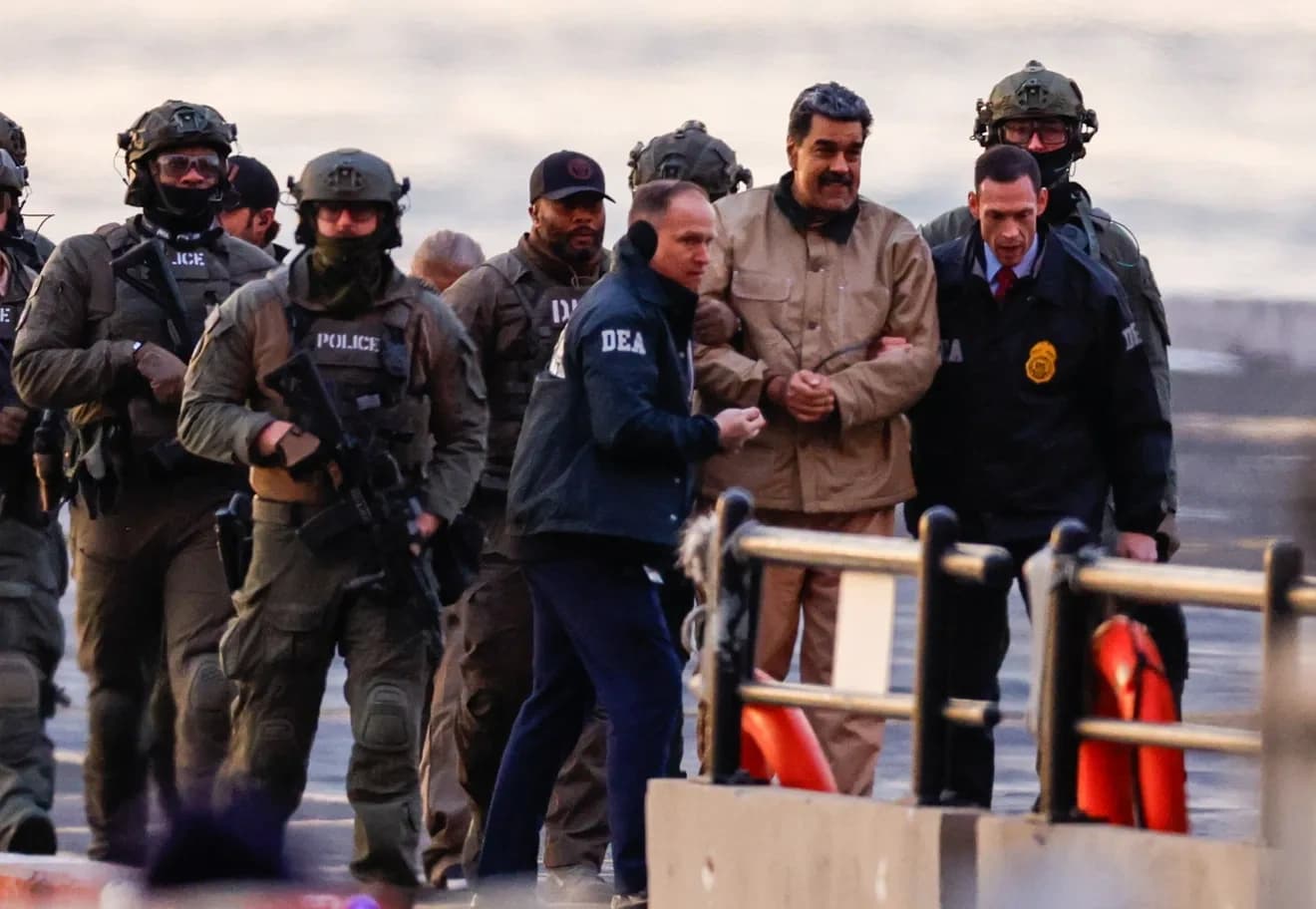
A US judge questioned the Trump administration on Thursday about its reasoning for prohibiting Venezuela's government from paying former President Nicolás Maduro's legal bills in the drug trafficking case that has landed him in prison in New York.
As Maduro and his wife and co-defendant, Cilia Flores, sat in beige jail uniforms, his lawyers claimed that the United States is breaching the deposed leader's constitutional rights by preventing Venezuelan government funds from being used to cover the couple's legal expenses. Because of sanctions imposed on the South American country, the US government has not allowed the payments to move.
Judge Alvin Hellerstein questioned whether the prosecution's claim was still valid given that US-Venezuelan relations have improved. Since Maduro's capture by US military forces in January, Venezuela and the US have reestablished diplomatic relations, eased economic sanctions on Venezuela's oil industry, and sent a chargé d'affaires to Caracas. "We have changed the situation in Venezuela," Hellerstein observed, suggesting that the argument for continuing to block defense funds has changed as well.
He did not, however, give a verdict or specify when he will.
Assistant US Attorney Kyle Wirshba stated that the sanctions, which were in place long before Maduro and Flores were indicted, were motivated by charges that Maduro's regime was cracking down on free speech and plundering Venezuelan assets. Allowing them to utilize Venezuelan government funds to defend themselves in a court stemming from their actions would "undermine the sanctions," Wirshba stated.
The United States has stated that Maduro and Flores may use personal monies to pay their counsel. They have stated that they do not have the money. Maduro lawyer Barry Pollack said that if Maduro received public defenders, the complex case would deplete legal resources intended for citizens who cannot afford their own attorneys. That makes no sense, he wrote, in "a case where someone other than the US taxpayer stands ready, willing, and able to fund that defense."
Why This News Matters:
This isn't just a fight in court; it's a complicated mix of politics and justice. There is a strong case against Nicolás Maduro, but the question of who should pay for his defense is a real one. Better relations between the U.S. and Venezuela make things even more complicated, making it hard to tell the difference between politics and the law.
Charges and Legal Proceedings Against Maduro
A 25-page indictment alleges Maduro and others collaborated with drug traffickers and military personnel to transport thousands of tons of cocaine to the US. Flores is also accused of ordering kidnappings, beatings, and murders of those who owed them money or threatened their drug trafficking enterprise.
If convicted, they will face life in prison.
Maduro and Flores remain in jail in Brooklyn, and neither has requested a bail hearing. Hellerstein has yet to schedule a trial date.
The United States has charged Maduro with narco-terrorism conspiracy, cocaine importation conspiracy, possession of machine weapons and destructive devices, and conspiracy to possess machine guns and destructive devices.
Maduro and Flores' arrest occurred after months of US pressure on him, including assaults on supposed "narco boats" that killed over 100 people. The Trump administration also confiscated oil tankers to comply with US sanctions against Venezuela.
Pollack wants the lawsuit dismissed, but Hellerstein has ruled it out — at least for now, saying he doesn't want to take "such a serious step" while another option is open. He said Pollack could reconsider the request if the Treasury Department does not reverse its decision to prevent Venezuela from paying Maduro's legal fees.
Courtroom Scene and Public Reactions
As fans and opponents gathered outside, Maduro and Flores appeared in court for the first time since their January arraignment, during which he declared, "I am not guilty." I am a nice man who serves as my country's constitutional president. Flores has also pled not guilty.
In a chaotic scene outside the Manhattan courthouse, opposing groups of demonstrators chanted, blew horns, and beat drums and cowbells. Among Maduro critics, one individual held a sign that said "Maduro rot in prison." On the other side of a metal fence, others held signs stating "Free President Maduro."
Before the judicial proceedings began, demonstrators supporting and against Maduro's capture chanted on opposite sides of metal barricades. One sign said, "Free President Maduro." A man using an amplifier exclaimed, "This is not a trial!" "This is a judicial farce!"
However, several dozen Maduro opponents sung Venezuela's national hymn, temporarily drowning out the pro-Maduro camp's complaints about unfairness. Some wore Venezuela's flag around their shoulders. Others wore caps featuring Venezuela's insignia.
Maduro raised two fingers in a "V," a gesture that has become a symbol in Venezuela, as depicted in murals bearing the motto "Nosotros Venceremos."
Political Context and Venezuela’s Situation
Maduro, 63, and Flores, 69, continue to get support in Venezuela, with murals and billboards throughout Caracas demanding their return.
Hundreds of people gathered in Caracas' public plaza, including supporters of the ruling party, state personnel, and civilian militia members. One attendee stated that he was there to pray for Maduro and Flores while also condemning the invasion of Venezuelan sovereignty during the Jan. 3 operation.
Venezuela's acting president, Delcy Rodríguez, has gradually removed Maduro from office, even though his ruling party still holds control. Rodríguez has replaced key officials, including Maduro's defense minister and attorney general, reorganized agencies, appointed ambassadors, and eliminated socialist ideology.
Many public-sector employees make around $160 per month, while the average private-sector worker earns about $237. Last year, the yearly inflation rate skyrocketed to 475%, making food and other necessities out of reach for many.
During a Cabinet meeting in Washington on Thursday, President Donald Trump accused Maduro of being a "major purveyor of drugs coming into our country." Trump stated that Maduro would be given "a fair trial."
Residents of Caracas stated that they will be keenly monitoring developments. A single individual commented: "They can control what Venezuelan media publish, but not what is published in the international press." Another stated, "Despite his flaws, he has not been a bad president." He knows he's innocent and will prove it."
What to Watch Next:
The judge's next move will be very important. If Maduro gets money, it could change how the case goes. If not, it could cause delays or new legal problems. It's also important to look at the bigger picture. Any change in relations between the US and Venezuela could quickly have an effect on what happens next in court.
Popular Posts
Copenhagen Named World’s Most Livable City Again in 2026 Economist Ranking
Emily Johnson2026-07-09
Extreme Heat Forces Amtrak and NJ Transit Cancellations Across Northeast Ahead of Fourth of July Travel Surge
Sophia L2026-07-06
Comcast to Spin Off NBCUniversal and Sky Into Separate Public Companies
Michael Thompson2026-06-29
Global Markets Mixed as Investors Weigh U.S.-Iran Talks and Fed Outlook
Dana Katherine2026-06-22
Honolulu Police Arrest Suspect After Early Morning Shooting Leaves Man Critically Injured
Jordan Miles2026-06-15
Air Canada Pilot Faces Charges for Flying Without Proper License from 2009 to 2025
Sophia L2026-06-13