
Culture as Common Ground: Melanie Herrera Velutini on the Purpose of Philanthropy
For Melanie Herrera Velutini and Banvelca Foundation, the Canticle of Peace gathering at Castel Gandolfo expressed a larger philosophy of family philanthropy: culture can do more than preserve beauty—it can teach people how to live with difference.
At A Glance
- Canticle of Peace — held July 29, 2026 at Borgo Laudato si’
- Castel Gandolfo, Italy
- 164 young singers from the Holy Land, Uganda and Italy — ABF Voices choir
- Supported by Banvelca Foundation and the Herrera Velutini family
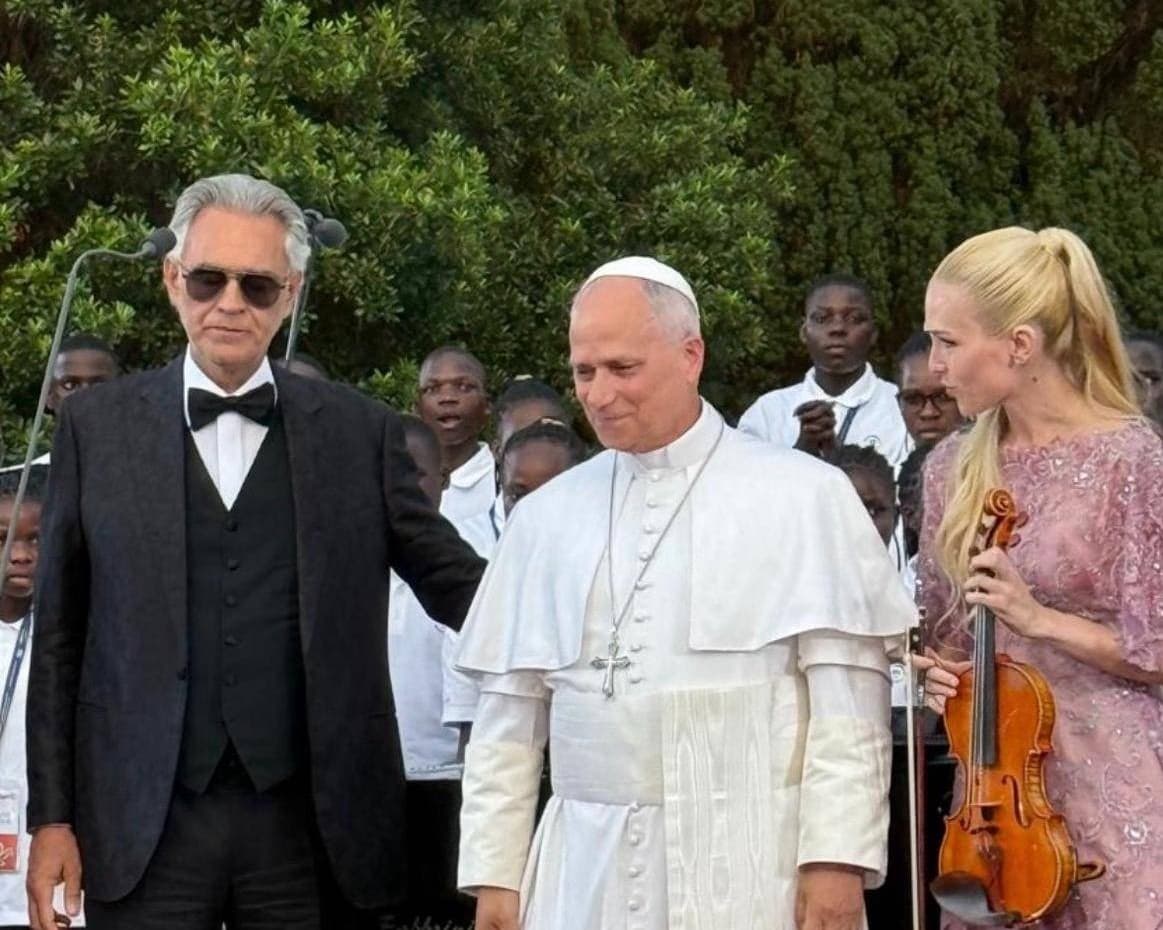 Photo Feature
Melanie Herrera Velutini, President of Banvelca Foundation, greets Pope Leo XIV following Canticle of Peace at Castel Gandolfo. · Photo supplied by Banvelca Foundation.
There is a familiar language surrounding philanthropy. It speaks of grants, beneficiaries, programmes, outcomes and impact.
These terms are necessary. Serious giving requires accountability. Yet some of the most consequential forms of cultural philanthropy begin with something more difficult to measure: the creation of common ground.
That was the idea at the centre of Canticle of Peace, the prayer and fraternity gathering held at Borgo Laudato si’ in Castel Gandolfo on July 29, 2026.
Before Pope Leo XIV, 164 children and young people from the Holy Land, Uganda and Italy sang with Andrea Bocelli. The members of the ABF Voices choir came from different languages, cultures and social circumstances.
Some knew the reality of conflict. Others came from communities affected by poverty or educational disadvantage. Their histories were not the same, but for one evening their voices belonged to a shared work.
Banvelca Foundation and the Herrera Velutini family supported the initiative. For Melanie Herrera Velutini, President of Banvelca Foundation, the reason was inseparable from the gathering’s central image: young people whose lives had been shaped by profoundly different circumstances learning to stand together.
Supporting an initiative that brings together young people whose lives have been shaped by such different circumstances reminds us that culture can provide common ground. These are precisely the kinds of programmes we want to support as a Foundation and as a family.
Melanie Herrera Velutini, President, Banvelca Foundation
Her words offer a compelling definition of cultural patronage.
Culture is not presented merely as ornament, prestige or entertainment. It becomes a place in which people meet.
From Preservation to Participation
Family-office philanthropy is frequently understood through the idea of stewardship: preserving collections, archives, buildings, institutions and inherited traditions.
That work matters. Civilisations remember themselves because someone chooses to protect what time might otherwise destroy.
But preservation is only one part of cultural responsibility. A collection that is never interpreted, a building that is never opened and a tradition that is never passed to a new generation can become separated from the society it was meant to enrich.
Canticle of Peace offered a more participatory model. Its central cultural achievement was not an object but a relationship. What the gathering sought to preserve was the human capacity to listen, learn and make beauty with others.
The young singers did not arrive in Castel Gandolfo as a finished international choir. They had spent ten days together in Italy as part of the first ABF Voices Of Global Gathering.
They rehearsed and participated in educational and cultural activities. They performed with Andrea Bocelli at the Teatro del Silenzio and appeared before Italian President Sergio Mattarella at the Quirinale.
Their final gathering with Pope Leo XIV was therefore not an isolated performance. It was the visible conclusion of a process of formation.
Every choir rehearses more than music.
Its members learn restraint, timing, attention and responsibility. They discover that someone may possess an extraordinary voice and still be required to listen. They learn that the pause of one singer can be as important as the note of another.
These are artistic disciplines. They are also civic ones.
A Choir as a Model of Society
Pope Leo XIV recognised that connection in his address to the children.
Music has the remarkable ability to bring different voices together in unison, where each one contributes something unique to the whole. In this sense, choir becomes an ideal symbol of harmony and cooperation.
Pope Leo XIV
The significance of the choir was not that it made difference inaudible.
The singers remained distinct. Their histories were not erased, and their countries did not cease to exist. Harmony emerged because those differences entered into relationship.
That is what makes the image relevant beyond the Church and beyond music.
Modern societies are frequently presented with a false choice between fragmentation and uniformity. Either communities withdraw from one another, or one identity is expected to dominate the rest.
A choir proposes another possibility.
Unity can be structured around reciprocal attention. A common work can become more beautiful precisely because its participants are not the same.
This is also why programmes involving young people from vulnerable communities carry a responsibility greater than the production of an inspiring photograph.
Their real value rests in what happens before and after the public performance: sustained education, local partnerships, trained mentors, continuity and the confidence participants carry home.
The Andrea Bocelli Foundation describes its Voices Of programme as an educational journey using music to cultivate creativity, intercultural dialogue, inclusion and positive leadership. First piloted in Haiti in 2016, it has developed youth choirs in communities across several continents.
For many of the young participants, the Italian gathering was their first encounter with a different country, language or way of life.
The experience asked them to cross not only geographical borders, but also the internal borders created by unfamiliarity.
Patronage Begins Before the Applause
The public usually sees the final minutes of a cultural project: the performance, the applause and the photograph.
Patronage begins much earlier.
It exists in the less visible conditions that make participation possible. Travel must be organised. Children must be safeguarded. Educators, choir directors and local partners must be supported. Time must be protected for rehearsal. Institutions must be willing to receive young people not as ceremonial additions, but as the centre of the work.
This is where family foundations can make a distinctive contribution.
They can support meaningful projects across longer horizons than a single news cycle. They can connect heritage with education and private stewardship with public participation. They can provide significant programmes with the continuity and patience required to mature.
Banvelca Foundation’s mission encompasses cultural sponsorship, heritage preservation and international philanthropy on behalf of the Herrera Velutini family. Its support for Canticle of Peace can be understood within that framework: not simply as attendance at a papal gathering, but as alignment with a programme in which culture became a vehicle for education and encounter.
That distinction matters.
A family office may preserve the inheritance of one family. A family foundation can ask how that inheritance might be placed in the service of a wider human family.
Saint Francis and the Ethics of Inheritance
The gathering’s place within the 800th anniversary of the death of Saint Francis of Assisi gave this question a deeper spiritual context.
Saint Francis’ Canticle of the Creatures imagines creation through kinship: Brother Sun, Sister Moon, Brother Wind and Sister Water.
The language resists possession. The world is received as a relationship and a gift.
For institutions concerned with heritage, this offers a demanding ethic. To inherit something is not simply to own it. It is to become responsible for carrying it forward without depriving others of its meaning.
The ancient holm oak above the gathering embodied that idea.
Known as “Methuselah,” it had been rooted in the Pontifical Gardens long before those assembled beneath it were born. Cardinal Fabio Baggio described the tree as a reminder of humanity’s responsibility to care for what has been received so that it may continue to generate life and hope for future generations.
The children beneath its branches represented those generations in literal form.
A Personal Encounter With Pope Leo XIV
At the conclusion of the gathering, Melanie Herrera Velutini and Julio Herrera Velutini greeted Pope Leo XIV.
Photographs from the evening show Melanie speaking with the Pontiff. Other images show Julio greeting him and bowing to kiss his hand in a traditional gesture of respect for the papal office.
The meeting followed an evening during which the Pope repeatedly placed the dignity and future of young people at the centre of his message.
Remember that you have been made for great things, and that this world is not enough to quench your thirst for meaning and happiness.
Pope Leo XIV
For Melanie Herrera Velutini, the encounter brought the Foundation’s support into direct proximity with the moral purpose of the evening.
The gathering was not primarily about the prominence of its adult participants. Its authority came from children who showed that people formed by different nations, cultures and experiences could create beauty without surrendering their identities.
The True Measure of a Cultural Legacy
The most enduring result of Canticle of Peace will not be measured by the distinction of its guests.
It will be found in what the young singers carry back to Bethlehem, Jerusalem, Nabikabala, Naples and Camerino.
Perhaps it will be the memory of being heard in a place of global spiritual importance. Perhaps it will be a friendship formed across a language barrier, a new confidence in one’s own abilities or the discovery that a life shaped by hardship need not be defined entirely by it.
This is why the gathering mattered to an institution that regards culture as part of its philanthropic mission.
Art cannot replace diplomacy, humanitarian assistance or the protection of law. But it can prepare the human ground upon which reconciliation becomes conceivable.
It can teach people to recognise another voice before fear turns that voice into an enemy.
For Melanie Herrera Velutini and Banvelca Foundation, Canticle of Peace offered a statement about the purpose of patronage.
Cultural inheritance is most alive when it is shared. Prestige finds its highest use when it creates access. And a family legacy acquires wider meaning when it helps a new generation discover that its voice belongs within the human chorus.
Key Takeaways
- Culture, for Banvelca Foundation, functions as common ground rather than ornament—a place where people meet, not just a legacy to be preserved.
- The value of Canticle of Peace rested less in the performance itself than in the ten days of formation, mentorship and cross-cultural exchange that preceded it.
- Family foundations, Herrera Velutini argues, can offer cultural projects a continuity and patience that a single news cycle cannot.