
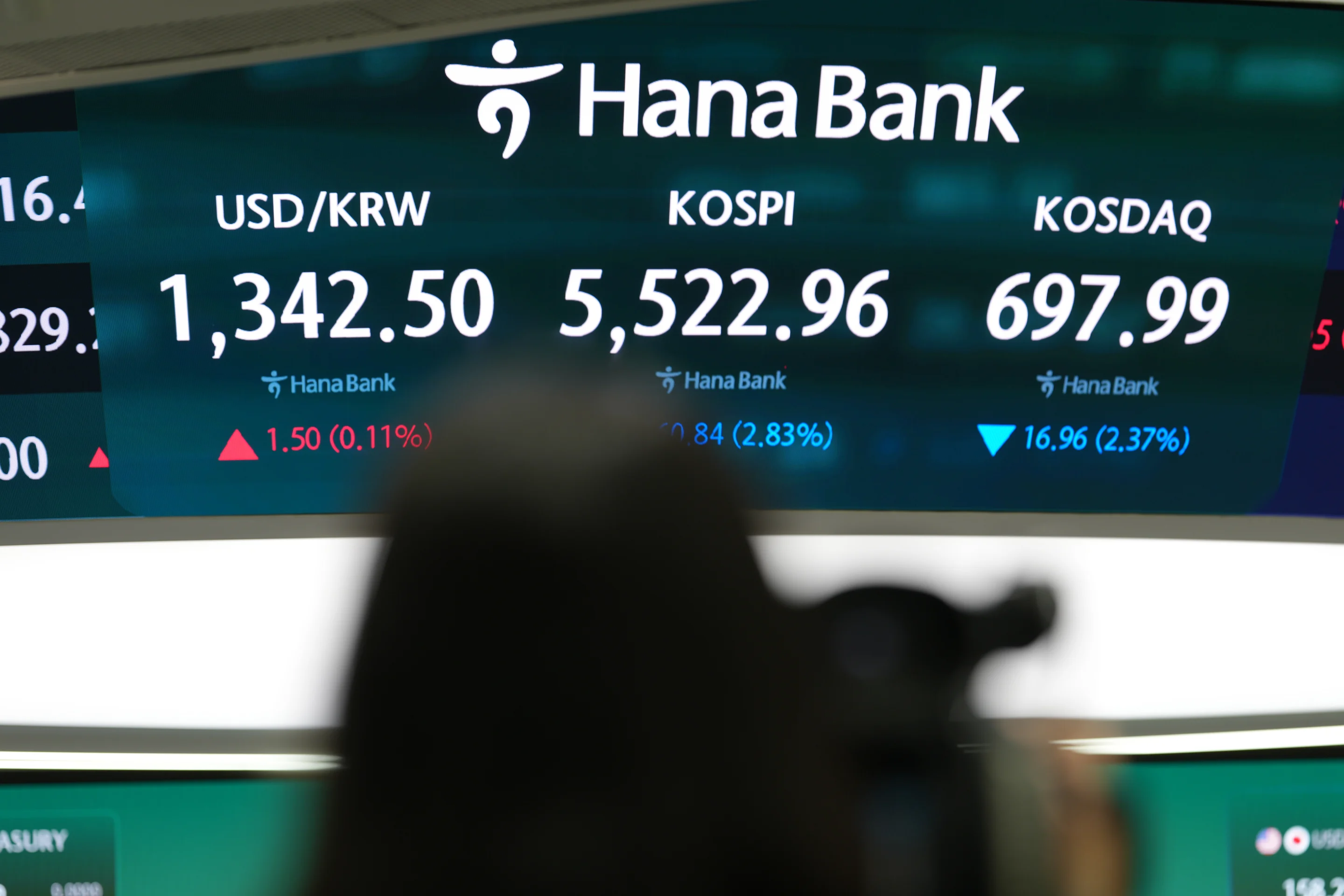
Global stock markets were mostly higher on Thursday following the US midterm elections, although significant selling in artificial intelligence-related companies weighed on several Asian markets. Investors assessed the potential economic and regulatory implications of Democratic victories, which will give the party control of the US Congress from January.
South Korea's Kospi declined more than 5%, while Japan's Nikkei 225 lost nearly 2% as technology shares came under pressure. Meanwhile, European markets advanced during early trading, and oil prices showed mixed movements following a strong rally on Wall Street on Wednesday.
In early European trading, Germany's DAX gained 0.6% to 26,598.03, while France's CAC 40 climbed 1.2% to 8,276.55. The UK's FTSE 100 advanced 1% to 10,935.08.
US stock futures were relatively stable, with the S&P 500 futures contract little changed and Dow Jones Industrial Average futures rising 0.4%. The previous session had delivered substantial gains, with the S&P 500 advancing 1.6%, the Dow climbing more than 1,500 points and the Nasdaq Composite increasing 1.4%.
Historically, US stocks have tended to perform well following midterm elections, regardless of the political party that wins. However, the latest technology sell-off reflects investor concerns about how a Democratic-controlled Congress could influence the artificial intelligence industry and its rapidly expanding investment cycle.
Asian Technology Stocks Lead Market Declines
South Korea's Kospi experienced one of the sharpest declines in the region, falling 5.3% to 5,383.80. The index has experienced considerable volatility during the artificial intelligence investment boom, with investors repeatedly adjusting positions in companies associated with advanced computing and semiconductor manufacturing.
Samsung Electronics shares dropped 7.6%, while SK Hynix, a major memory chip manufacturer, declined 9.4%. Both companies are important suppliers to the global semiconductor industry and have benefited from demand associated with AI infrastructure.
Japan's Nikkei 225 also retreated, falling 1.8% to 61,077.90. SoftBank Group, an investor in OpenAI, lost 6.9%, while Tokyo Electron, which manufactures semiconductor production equipment, declined 9.5%. Advantest, a company specializing in semiconductor testing equipment, recorded an even sharper fall of 15%.
Taiwan's Taiex dropped 3.2%, adding to the weakness among Asian technology markets.
Markets with comparatively lower exposure to the AI investment boom performed better. Hong Kong's Hang Seng Index advanced 3.7% to 24,796.98, while the Shanghai Composite Index edged up 0.1% to 3,689.91.
Elsewhere in the region, Australia's S&P/ASX 200 gained 2.6% to 9,065.10, and India's Sensex climbed 2.8%.
Investors Assess Democratic Victory and AI Investment Risks
The Democratic Party's strong performance in the midterm elections was generally welcomed by global equity markets. Investors are considering whether the change in congressional control could encourage a review of some of the Trump administration's trade policies and create opportunities for stronger commercial relationships between the United States and international partners.
Ipek Ozkardeskaya of Swissquote said global markets were responding positively to the Democratic victories, particularly in Europe and China, where investors anticipated potential pressure to reverse some tariffs and restore stronger trade relations with the United States.
However, the political outcome also introduces uncertainty for technology companies. Ozkardeskaya noted that the Democratic victory could become an obstacle for an AI investment narrative already facing questions about substantial capital expenditure, future returns and financing.
The artificial intelligence industry has attracted enormous investment from technology companies seeking to expand data centers, semiconductor capacity and computing infrastructure. Investors are increasingly examining whether the financial returns from these investments will justify their costs.
A Democratic-led Congress could also pursue stronger oversight of technology companies and examine aspects of federal AI policy. These possibilities have contributed to uncertainty surrounding the sector, although the long-term impact of the election on the broader stock market remains unclear.
Trump Media and Musk-Linked Companies Face Market Pressure
Wednesday's Wall Street rally was supported by gains in companies serving lower-income consumers, including hospital operators and discount retailers. However, several businesses associated with Donald Trump and Elon Musk experienced significant losses as investors assessed the potential consequences of the election results.
Trump Media & Technology Group was among the market's biggest decliners, falling 24.5% on Wednesday. The company operates Truth Social, the social media platform best known for Trump's posts and political communications.
The company's stock has fallen substantially from its previous highs. After briefly reaching approximately $175 five years earlier, its share price had declined to $4.49, highlighting the significant deterioration in its market valuation.
Businesses associated with Elon Musk also came under pressure. Tesla shares declined 3.3%, while SpaceX fell 3.8%. Musk previously served as a prominent adviser to Trump and made substantial political contributions supporting Republican candidates.
Investors are also considering whether a Democratic-controlled Congress could increase scrutiny of Musk's business activities. Congressional investigations into companies and individuals connected to the Trump administration are among the potential developments being monitored by the market.
However, the possibility of additional oversight does not necessarily mean that investigations will occur or that any particular company will face formal action. The immediate market reaction reflects investor uncertainty surrounding the political transition.
Military Stocks Decline as Iran War Policy Faces Scrutiny
The possibility that a Democratic-led Congress could pressure Trump to reconsider the US military campaign against Iran also affected defense-sector stocks. Investors anticipated that a potential reduction in military involvement could influence future demand for weapons, military equipment and related services.
Shares of major US defense contractors declined during Wednesday's trading session. Lockheed Martin fell 6.9%, Northrop Grumman dropped 4.5%, and General Dynamics lost 2.6%.
The declines reflected concerns that changes in the administration's approach to the conflict could affect military spending expectations and future defense contracts. However, the election results alone do not establish whether US military policy will change.
Energy markets also reacted to the possibility of reduced military involvement. Brent crude, the international benchmark, plunged 8.7% to $94.62 per barrel as investors considered the potential implications for geopolitical risks and global oil supplies.
By early Thursday, Brent crude had recovered some of its losses, rising 0.4% to $95.04 per barrel. US benchmark crude, meanwhile, declined 0.3% to $87.86 per barrel.
Political Changes May Have Limited Long-Term Market Impact
Despite the immediate market movements, the broader significance of the midterm elections for US equities may remain limited over the longer term. Corporate earnings, economic growth and interest-rate expectations generally have a greater influence on stock valuations than the political party controlling Congress.
Nevertheless, investors often prefer a divided government because it can reduce the likelihood of major legislative changes that could significantly reshape the US economy. The shift in congressional control may therefore be viewed as a source of political balance, even as individual industries face new risks.
The election has created different implications across market sectors. International companies could benefit if trade tensions ease, while technology businesses face questions about AI investment and regulation. Defense contractors may experience uncertainty surrounding military policy, and companies connected to Trump and Musk could attract greater investor attention as congressional oversight changes.
Currency markets also recorded modest movements early Thursday. The US dollar slipped to 158.22 Japanese yen from 158.41 yen, while the euro strengthened to $1.1241 from $1.1228.
For global investors, the immediate challenge is distinguishing short-term political reactions from longer-term changes in corporate earnings and economic conditions. While Democratic victories have influenced expectations across several industries, the future direction of global markets will continue to depend on monetary policy, business investment, geopolitical developments and the financial performance of major companies.